10 Aug 2026
Passive Income from Commercial Real Estate: A Beginner's Guide
Somewhere between "buy a flat and let it sit" and "start a business," there's commercial real estate, an asset with a lot of first-time investors to circle around without fully understanding. The appeal is obvious: a tenant pays rent; you don't clock anywhere, and the property keeps working for you. The reality is a little more layered than that, and this guide on passive income commercial real estate is meant to walk through it.
What is "Passive Income"
In commercial real estate, passive income refers to the rental income a property generates once it's leased out, income that doesn't require your daily involvement the way an active business would. That said, "passive" doesn't mean "hands-off forever." There's due diligence before you buy, tenant management after, and ongoing decisions about maintenance, renewals, and upkeep. Passivity is relative.
What Actually Drives Rental Demand
Before assuming any commercial unit will generate steady income, it helps to understand what real estate professionals look at when assessing a property's income potential:
Location and connectivity. A unit on a well-connected road with visibility and easy access tends to attract tenants faster than one tucked away in a low-traffic pocket.
Footfall and catchment population. Retail and office spaces both depend on the number of people who realistically pass by or live/work nearby. A larger catchment population generally supports a wider tenant pool.
Parking and infrastructure. For both retail and office tenants, adequate parking is often a deciding factor, especially in developments that expect high daily visitor or employee volume.
Tenant mix in the surrounding development. A commercial space inside a larger, well-planned development tends to benefit from the pull of neighbouring businesses, rather than having to draw footfall entirely on its own.
Type of space. Offices, studios, and retail units attract different categories of tenants with different lease durations and different sensitivities to location and layout. Understanding which category fits your budget and expectations is a first step, not an afterthought.
Gaur City Center Fits Into This Framework
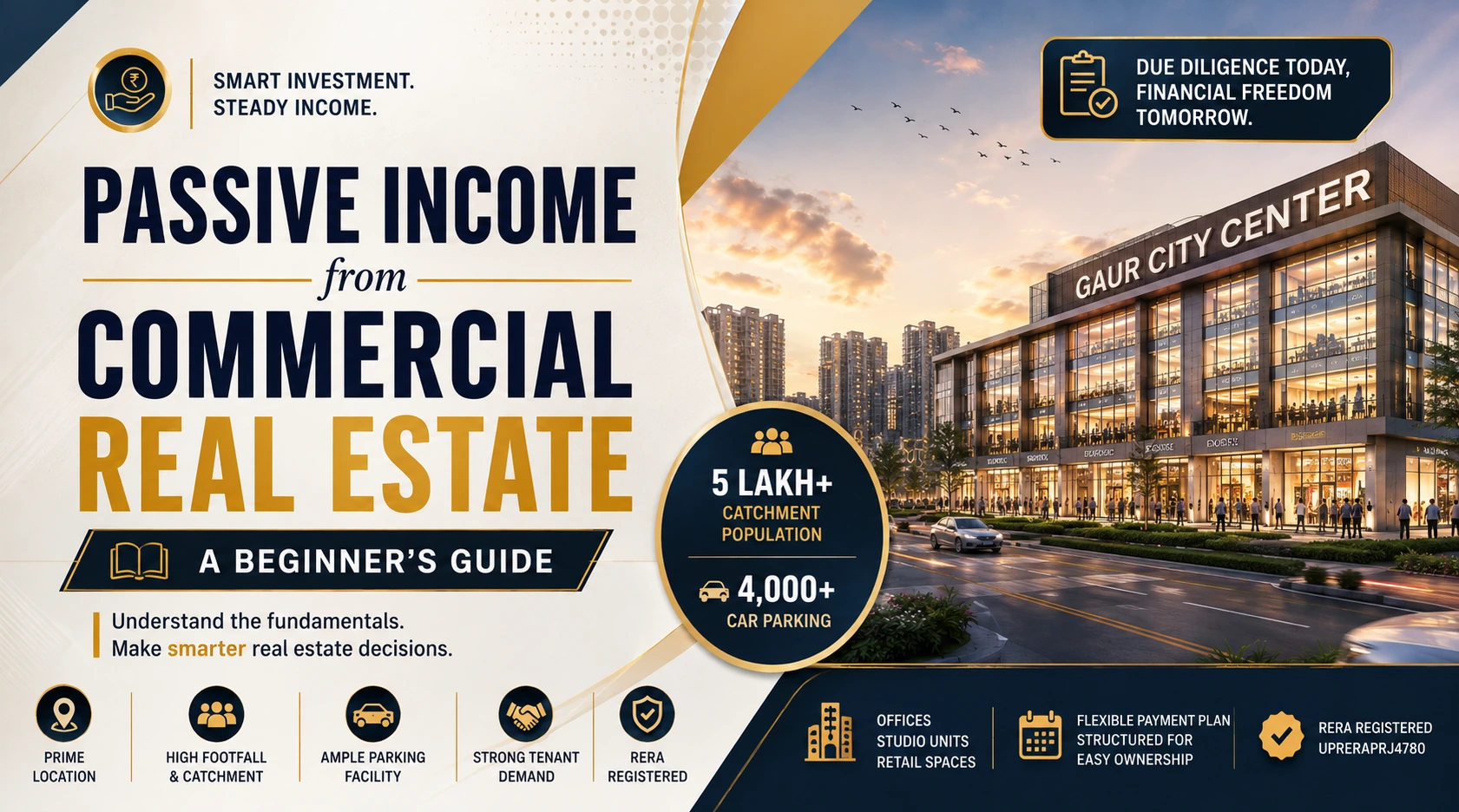
Gaur City Center, located at Gaur Chowk in Greater Noida West, is a commercial development with offices, studio units, and retail spaces. Looking at it through the lens above:
· It's positioned along a 130-meter-wide road, which is relevant to the visibility and accessibility factor discussed above.
· It offers multi-level parking designed for close to 4,000 vehicles, addressing one of the more practical concerns tenants and customers raise about commercial spaces.
· The development is positioned within a catchment of over 5 lakh people, which is a factor worth weighing when assessing potential tenants and customer reach.
· Possession for offices and studio units is linked to 40 percent of the payment plan, and for retail spaces to 30 percent, structured through a staggered payment schedule rather than a lump sum.
These are structural and locational factors, the kind that real estate professionals typically assess when evaluating a commercial property's income potential. They are not a guarantee of rental returns, which depend on market conditions, tenant demand at the time of leasing, and how the surrounding development matures.
What Beginners Often Get Wrong
Assuming higher price means higher rent. A more expensive unit doesn't automatically command proportionally higher rent. Location and footfall usually matter more than the base price per square foot.
Skipping RERA verification. Every commercial project should be checked against its RERA registration before any commitment. Gaur City Center, for instance, is registered as UPRERAPRJ4780, verifiable on the UP RERA portal.
Not accounting for the vacancy period. Between possession and finding a tenant, there's usually a gap. Beginners often plan finances assuming rental income starts immediately, which is rarely the case.
Ignoring maintenance and association costs. These recurring costs eat into whatever income the property generates and should be factored in from day one, not treated as a surprise later.
A Realistic Way to Approach It
Rather than chasing a specific return figure, a more grounded approach is to evaluate the fundamentals: location, connectivity, footfall, parking, and the credibility of the developer and RERA registration. These fundamentals don't promise a number, but they're the closest thing to a reliable filter when comparing one commercial property against another.
Commercial real estate can be a genuine source of income, but "passive" doesn't mean "effortless" or "guaranteed." The properties that tend to perform better over time are the ones with strong fundamentals, location, connectivity, footfall, and verified compliance, not the ones with the highest headline numbers. If you're evaluating a development like Gaur City Center, look past the brochure and check these fundamentals for yourself before deciding.
FAQs
Is commercial real estate a good source of passive income for beginners?
It can be, provided the buyer does proper due diligence on location, tenant demand, and the developer track record before investing, rather than treating any purchase as automatically income-generating.
How is buying an office different from buying retail space for rental purposes?
Office spaces typically attract longer-term corporate tenants, while retail spaces depend heavily on footfall and visibility. The right choice depends on the buyer's budget, risk appetite, and the specific location's strengths.
Does a larger catchment population guarantee higher rental demand?
It's a positive indicator, not a guarantee. Catchment size is one of several factors that influence tenant interest; execution, timing, and market conditions also play a role.
What should I check before buying a commercial unit for rental income?
At minimum: RERA registration, the developer's delivery history, the payment plan structure, parking and connectivity, and the surrounding catchment and footfall.
Just fill out the form below
I authorise company representatives to Call, SMS, Email, or WhatsApp me about its products and offers. This consent overrides any registration for DNC/NDNC.
Category
Gaur City Center Commercial Property
I authorise company representatives to Call, SMS, Email, or WhatsApp me about its products and offers. This consent overrides any registration for DNC/NDNC.