2 Jul 2026
Office Space Investment in Greater Noida West
2026 ROI Analysis
There is a particular satisfaction that comes from spotting a good opportunity before everyone else does. Not through luck, but through simply paying attention to what the numbers are already saying. For investors tracking Greater Noida West, 2026 feels like exactly that kind of moment.
This analysis is structured as any thoughtful investment decision should be: by comparing yield against yield, location against location, and timing against timing. Here is what that comparison reveals about the office space investment ROI Greater Noida West investors are currently evaluating.
Starting With the Number That Matters Most
Every meaningful ROI conversation begins with income. Residential property in Greater Noida West, even in well-located apartment towers, typically generates rental yields of around 2.5% to 3.5% annually.
On a sixty-lakh apartment, that comes to roughly 1.5 to 2.1 lakh a year, or about 12,500 to 17,500 a month. Against a standard EMI, most residential landlords in the corridor end up covering a little more than half their loan repayment through rent alone.
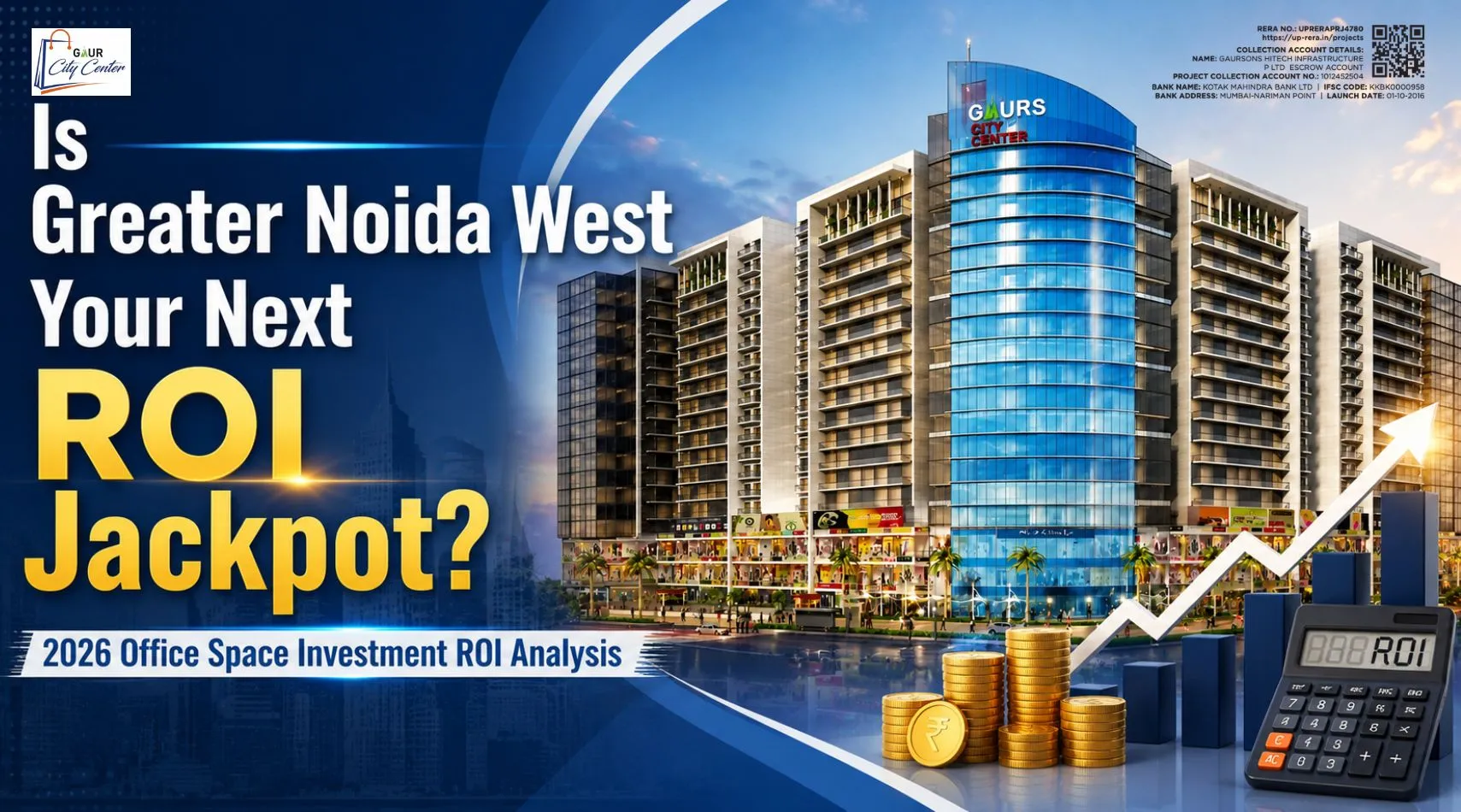
Commercial office space tells a genuinely different story. Well located office investment in Greater Noida West's established commercial corridors, including developments such as Gaur City Center, has been generating yields of up to 12%, nearly double the residential figure, often from a smaller capital outlay.
A four hundred to five hundred square foot unit acquired at a fraction of an equivalent apartment price can produce comparable or even higher monthly income, thanks to how commercial yield economics work.
This is the foundation of the ROI case here. It is simple arithmetic that any investor can check for themselves against comparable listings in the corridor.
Why Location Continues to Do the Heavy Lifting
Greater Noida West's growth over the past decade has been built on a steady, expanding residential population that has turned what was once a quieter zone into one of NCR's genuinely active commercial corridors.
The one hundred and thirty metre wide road at Gaur Chowk, where Gaur City Center is located, offers a good sense of this shift. Roads of this scale support strong vehicular visibility and easy access, both of which directly support footfall dependent commercial performance.
Regional connectivity strengthens the picture further. NH-24 sits approximately four kilometres away, Sector 71 in Noida is roughly seven kilometres out, and the Delhi border is about nine and a half kilometres from the corridor's key commercial addresses.
What matters most for a 2026 ROI analysis, though, is the approved metro station at Gaur Chowk, positioned at walking distance from major commercial developments in the area.
Current pricing across the corridor still reflects existing road connectivity. It has not yet caught up with the value a functioning metro station typically brings to nearby commercial real estate. That gap is where a meaningful share of future appreciation is likely to come from.
The Catchment Behind the Numbers
Yield and location only tell part of the story. The other part is demand, and in Greater Noida West, demand is tied closely to a residential population that keeps growing.
Gaur City, the integrated township anchoring much of this corridor's commercial activity, is already home to more than 1.5 lakh residents across upwards of 29,000 families, with the wider vicinity expected to serve a catchment approaching 5 lakh residents as the area continues to mature.
This is not a projected audience waiting somewhere in the future. It is a population already living, working, and spending within the corridor, exactly the kind of demand that supports consistent occupancy over time.
For an investor building an ROI model, this genuinely helps reduce one of the biggest uncertainties in commercial real estate, whether tenants will actually show up. Here, they largely already have.
Why Developer Track Record Deserves a Place in Every ROI Calculation
Most ROI models focus heavily on yield and appreciation, and often overlook the variable most likely to influence both, developer delivery.
In Greater Noida West, that experience varies across projects. Developments backed by operators with a long, well documented delivery history tend to offer far more confidence than newer or less established alternatives.
Gaurs Group, active in NCR real estate since 1995, has built a retail and commercial portfolio spanning 35 projects and approximately 53 lakh square feet of built up area, a track record investor can independently verify rather than simply take on faith.
Gaur City Center itself, registered under RERA number UPRERAPRJ4780 and verifiable at www.up-rera.in, is further supported by loan facilitation from a wide panel of lenders. This level of institutional participation reflects genuine due diligence, documentation, title, and financial structure that multiple banks have already reviewed well before an individual investor begins their own assessment.
Factoring this into an ROI model does not change the yield calculation directly, but it meaningfully improves the likelihood that projected returns are actually realised on schedule.
Bringing the ROI Case Together
When you analyze the facts side by side, the case for the office space investment ROI Greater Noida West offers in 2026 rests on four factors working in harmony rather than in isolation: rental yields that comfortably outperform residential alternatives in the same geography; a location where both road and metro connectivity are structurally strong; a resident catchment that is already substantial and still growing; and developer credibility that meaningfully reduces the delivery risk many ROI models tend to underweight.
None of these factors alone would be a strong enough reason to invest. Together, they form a complete and genuinely encouraging picture, one where the yield is available today, the appreciation story is still ahead, and the population that will sustain both is already living right next door.
For investors comparing this corridor with more established NCR commercial addresses, the takeaway is simple. The fundamentals here are catching up to the pricing, not the other way around. That kind of sequencing is usually where the better entry points are found.
FREQUENTLY ASKED QUESTIONS
Q1. How does office space investment ROI in Greater Noida West compare to residential property in the same corridor? Residential property in Greater Noida West typically generates rental yields of around 2.5% to 3.5% annually, while well located office space investment in the corridor, including addresses such as Gaur City Center, has been generating yields upto 12%. This means commercial office space can produce comparable or higher monthly income from a smaller capital outlay than residential alternatives in the same geography.
Q2. What role does metro connectivity play in the ROI case for this corridor? The approved metro station at Gaur Chowk, positioned at walking distance from major commercial developments in the area, has not yet been fully reflected in current property valuations. Since pricing still reflects existing road connectivity rather than future metro access, investors entering now are well placed to benefit from potential appreciation once the station becomes operational.
Q3. How significant is the resident catchment in Greater Noida West for commercial demand? The catchment here is substantial and continues to grow. Gaur City township alone is home to more than 1.5 lakh residents across upwards of 29,000 families, with the wider vicinity expected to serve a catchment approaching 5 lakh residents as the corridor matures. This existing and expanding population directly supports strong occupancy demand for office and retail space.
Q4. Why does developer track record matter when calculating ROI for office space investment? Developer delivery experience is one of the most valuable, yet often overlooked, variables in ROI calculations. Established developers with a long, verifiable history, such as Gaurs Group, active since 1995 with 35 retail and commercial projects covering approximately 53 lakh square feet, offer greater confidence around timely delivery. RERA registration and multi bank loan facilitation add further layers of verifiable transparency.
Q5. Is Greater Noida West a good entry point for first-time commercial investors in 2026? The corridor offers genuinely accessible entry costs compared with premium NCR commercial addresses, without compromising infrastructure fundamentals such as wide road connectivity, approved metro access, and an established residential catchment. Combined with rental yields that outperform residential alternatives, this makes it a solid starting point for investors exploring commercial real estate for the first time, provided they verify project-specific RERA registration and developer credentials independently.
Just fill out the form below
I authorise company representatives to Call, SMS, Email, or WhatsApp me about its products and offers. This consent overrides any registration for DNC/NDNC.
Category
Gaur City Center Commercial Property
I authorise company representatives to Call, SMS, Email, or WhatsApp me about its products and offers. This consent overrides any registration for DNC/NDNC.