11 Aug 2026
How Township Development Boosts Commercial Property Value
Ask any real estate professional what separates a thriving commercial unit from a struggling one, and location comes up first, every single time. But "location" on its own is a vague word. What actually gives a location its strength is the township development surrounding it: the residential density, the connectivity, and the planned infrastructure that brings people to the area in the first place. Once you understand that connection, evaluating any commercial property gets a lot easier.
What a Township Development Provides
A planned township isn't just a cluster of buildings sitting next to each other, it's an ecosystem. Residential blocks bring a resident population, which in turn creates consistent, dependable footfall for the commercial spaces nearby. Wide roads and organized infrastructure make the area easier to reach, both for residents and for visitors coming in from outside for work, shopping, or services. Over time, this combination is exactly what turns a commercial unit from an isolated, hopeful shop into a space genuinely embedded in daily foot traffic.
Why This Matters More for Commercial Property
Residential property value tends to ride on lifestyle factors: layout, amenities, greenery, the feel of the place. Commercial property value works differently, driven far more directly by people: how many are around, how easily they can reach the space, and how often they pass by it. This is precisely why the same commercial unit can perform very differently depending on whether it sits inside a well-developed township or on an isolated plot with little surrounding density.
A few specific township factors that shape commercial performance:
Catchment population. The number of people living and working within a reasonable radius directly affects the potential customer or tenant base for any commercial space nearby.
Road width and connectivity. Wider roads support higher traffic flow and stronger visibility for retail and office frontages, and make the location genuinely easier to access from surrounding areas.
Parking infrastructure. In dense townships, adequate parking becomes a real differentiator. A commercial space with limited nearby parking can lose footfall to a competing space that offers it, even if everything else is equal.
Planned versus organic growth. A deliberately planned township tends to have more predictable infrastructure, roads, drainage, utilities, laid out in advance, compared to areas that grow organically without any central plan guiding them.
Gaur Chowk and Gaur City Center as a Living Example
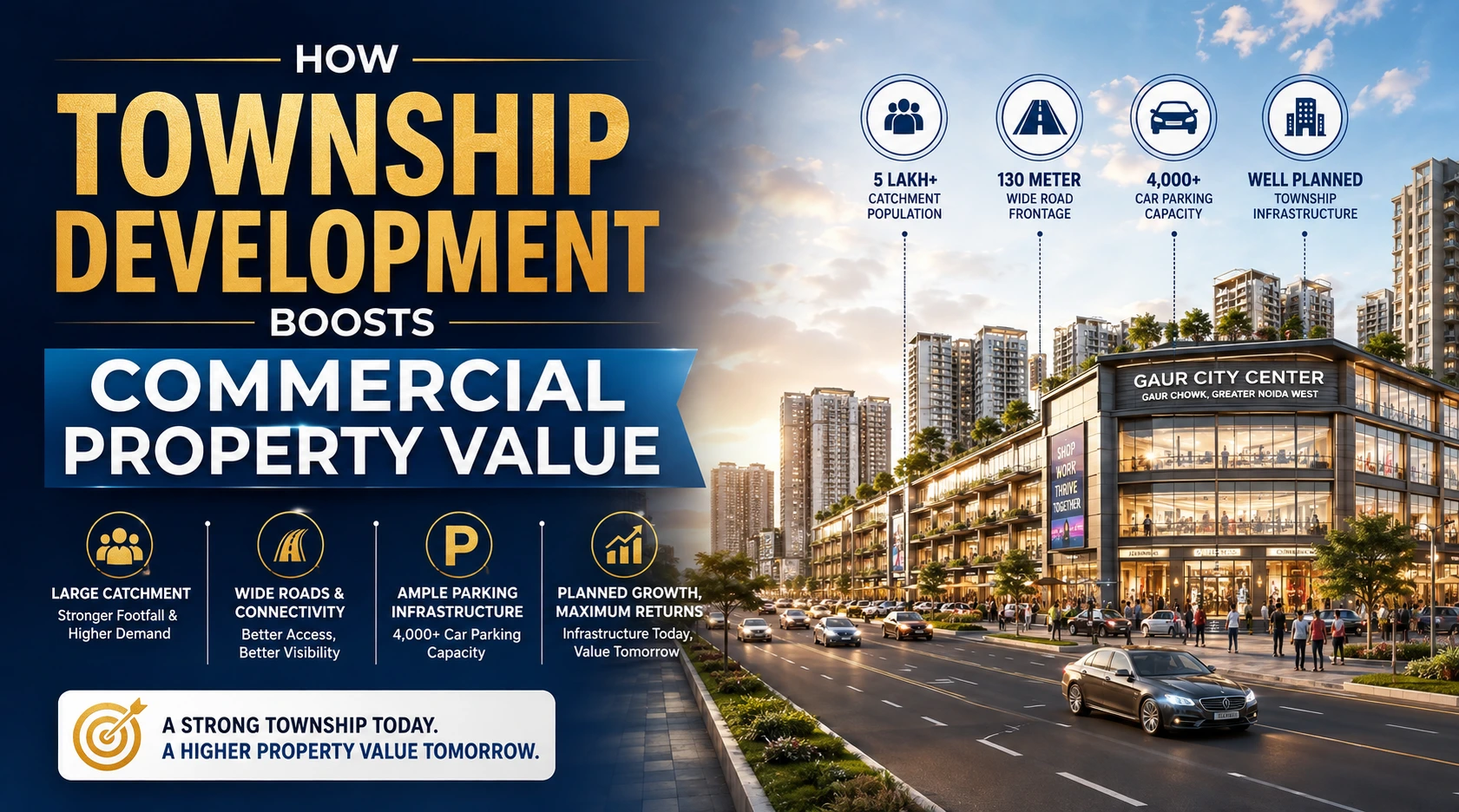
Gaur City Center sits at Gaur Chowk in Greater Noida West, an area shaped substantially by the township development around it. A few concrete details worth noting: the project fronts a 130-meter-wide road, directly relevant to the connectivity and visibility factors discussed above. It includes multi-level parking designed for around 4,000 vehicles, addressing a common friction point for commercial spaces in dense areas before it even becomes one. And it's positioned within a catchment of over 5 lakh+ people, a scale of surrounding population that's a direct outcome of the broader township development around Gaur Chowk.

* Prices, payment plans, availability and other project details are subject to change without prior notice. Kindly check with the authorized representative for the latest prices and updated payment plans before making any decision.
These factors, catchment, connectivity, and parking, are structural characteristics tied to the surrounding township, not just the individual commercial units themselves. They're exactly the kind of details that matter more over the long run than the finish or layout of any single unit, and they're worth understanding before comparing price tags across projects.
How to Evaluate This for Any Commercial Purchase
If you're comparing commercial properties across different townships or locations, a few grounded questions help cut through the noise:
· How large and established is the residential catchment around this specific commercial pocket?
· Is the surrounding infrastructure, roads, parking, planned and already functional, or still dependent on future development that may or may not arrive on schedule?
· Does the commercial space benefit from footfall generated by the township itself, or does it need to attract customers entirely on its own?
· Is the project's RERA registration in order, which can also be a useful indicator of the project's regulatory standing within the broader township plan?
Gaur City Center, for reference, is registered under RERA (UPRERAPRJ4780), independently verifiable on the UP RERA portal.
The Long-Term Angle Worth Remembering
Townships mature over time. Roads that feel underused today often carry significantly more traffic a few years down the line as surrounding phases complete and populations settle in. This is exactly why evaluating a commercial unit purely on its current state can miss the bigger picture. Looking at the township's overall development trajectory, how much is already built versus planned, how the developer has phased delivery, gives a far more complete read on where the location is actually heading.
The Ripple Effect Buyers Often Miss
There's a compounding quality to township growth that's easy to underestimate. Every new residential tower that gets occupied adds to the catchment. Every completed road segment adds to connectivity. Every operational parking structure removes a friction point for visitors. None of these individually feels dramatic, but stacked together over a few years, they can meaningfully shift how a commercial pocket performs. This is why evaluating a township's trajectory, not just its present state, tends to separate more informed buyers from the rest.
A commercial unit never performs in isolation, it performs within the ecosystem the surrounding township creates around it. Catchment population, road connectivity, and parking infrastructure are the practical, checkable factors that tie township development to commercial property performance. Developments like Gaur City Center at Gaur Chowk are worth evaluating specifically on these fundamentals rather than on the unit alone, since it's the township around it that ultimately does much of the heavy lifting.
FAQs
Why does a township matter more for commercial property than for residential? Commercial value depends heavily on footfall and accessibility, both of which are directly shaped by the surrounding residential density and infrastructure that a township provides.
Does a larger catchment population always mean better commercial performance?
It's a strong contributing factor, but not the only one. Connectivity, parking, and the specific commercial format, office, retail, or studio, also play a meaningful role in how well a unit performs.
How can I check if a township infrastructure is actually developed, not just planned?
Site visits, checking road and utility status on the ground, and reviewing the developer's track record on delivering previous phases are practical, reliable ways to verify this beyond brochure claims.
Is parking really that significant factor in commercial value?
Genuinely, yes. Particularly in dense townships, where limited parking can directly reduce footfall to a commercial space regardless of how strong the location otherwise appears.
Just fill out the form below
I authorise company representatives to Call, SMS, Email, or WhatsApp me about its products and offers. This consent overrides any registration for DNC/NDNC.
Category
Gaur City Center Commercial Property
I authorise company representatives to Call, SMS, Email, or WhatsApp me about its products and offers. This consent overrides any registration for DNC/NDNC.