
8 Aug 2026
How to Choose the Right Builder Payment Plans
Two numbers separated by a colon. That's it. And yet those two numbers can quietly decide how comfortable, or how stressful, the next two or three years of your finances are going to feel.
You've probably seen them on a price sheet already: 40:60. 30:70. 90:10. They look almost decorative, tucked into a corner of the brochure next to the floor plan. But every single one of them is really a builder payment plan for a commercial property, spelled out in shorthand, and it deserves a closer look before you sign anything.
Here's the good news. Once you understand how these plans work, you'll never feel confused reading a price sheet again. Let's break it down properly.
Wait, What Exactly Is a Payment Plan?
A payment plan has nothing to do with the actual price of your unit. That number stays fixed. What a payment plan controls is the timing of your outflow, when each instalment is due, and what triggers it.
Some plans ask for more money early. Others let you hold onto your cash longer and pay closer to possession. Neither is universally better. The right one depends entirely on your own financial rhythm.
The Four Payment Plans You'll Actually Encounter
Construction Linked Plan (CLP) This is the most common structure across commercial spaces. You pay in instalments as construction hits specific milestones: foundation, slab casting, superstructure, finishing, and so on. It feels transparent because your money and the building's progress move together.
Down Payment Plan Here, a large chunk, often 90 to 95 percent, is paid upfront in exchange for a discount. This suits buyers who already have liquid funds and would rather lock in savings than stretch payments over years.
Possession Linked Plan The opposite approach. You pay a smaller amount now and the bulk closer to handover. This works well if your income or liquidity is expected to strengthen later, say from a maturing investment or a bonus cycle.
Flexi or Subvention Plans A hybrid model where part of the payment is deferred, sometimes with interest support built in until possession. These vary a lot from project to project, so reading the fine print isn't optional here, it's essential.
So Which Plan Actually Fits You?
Before signing anything, sit with these four questions honestly:
· Is your money more available right now, or will it be stronger later?
· How comfortable are you with the builder's construction timeline?
· Are you taking a loan? Most lenders prefer construction linked plans since disbursement follows verified progress, not just a calendar date.
· Does the builder have a track record of delivering on time? Even the most attractive plan means little if possession keeps slipping.
Let's Consider an Example
Numbers make more sense with a real project attached to them, so let's look at Gaur City Center, located at Gaur Chowk in Greater Noida West.
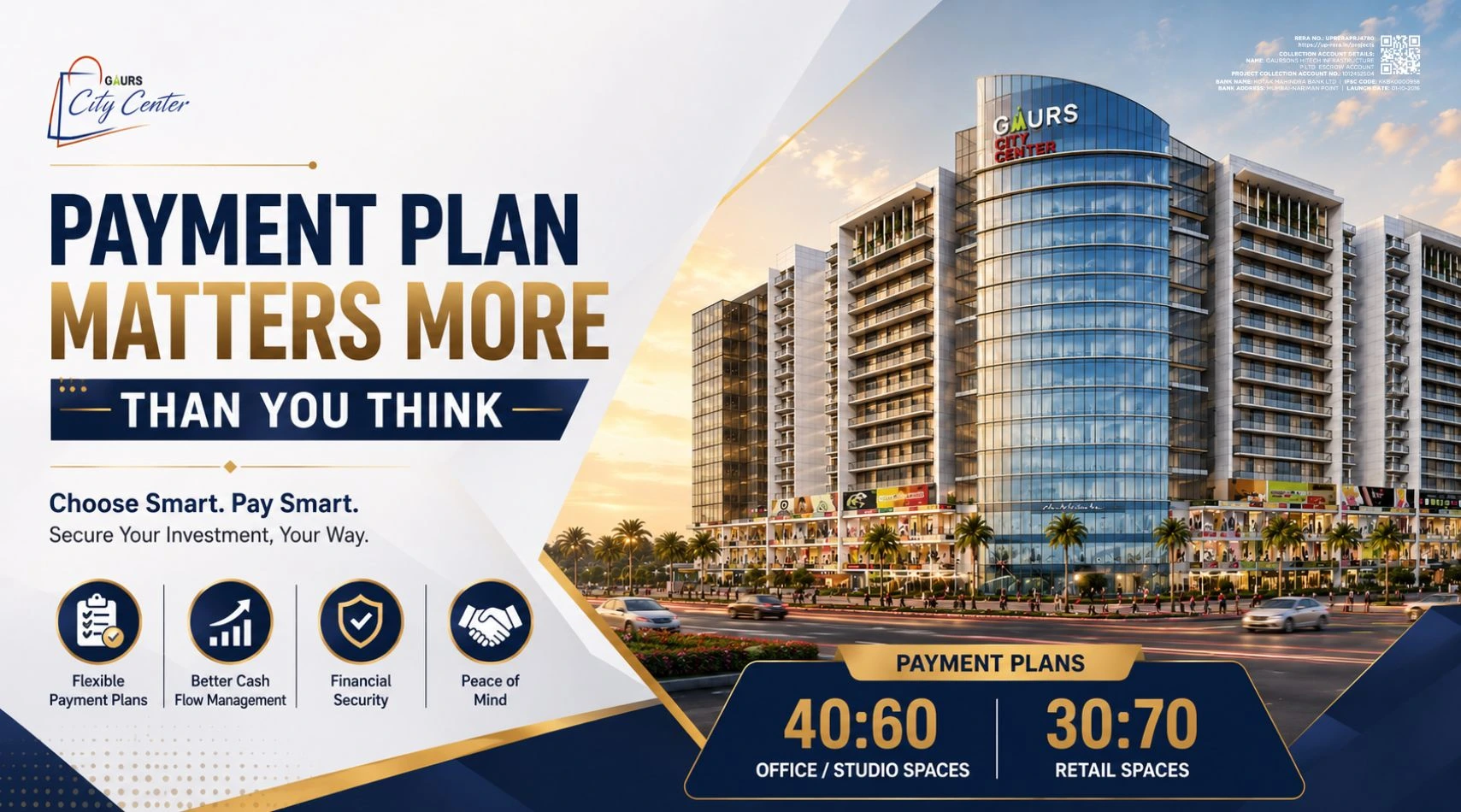
Its commercial inventory runs on two different structures depending on what you're buying. Offices and studio spaces follow a 40:60 payment plan, where 40 percent is paid across the construction period and the remaining 60 percent falls due closer to possession. Retail spaces, on the other hand, follow a 30:70 structure, front-loading a smaller share upfront.
There's a logic to this split. Office and studio buyers tend to prefer a manageable, staggered outgo they can plan around month to month. Retail buyers, meanwhile, often weigh location and footfall so heavily that they're willing to accept a plan weighted toward possession. It's a small structural decision, but it shapes who each category ends up attracting.
One more thing worth doing before you commit to anything: verify the project's RERA registration independently. Gaur City Center is registered under UPRERAPRJ4780, and you can confirm this directly on the UP RERA portal rather than taking anyone's word for it.
A Few Mistakes That Trip Up First-Time Buyers
Even seasoned investors slip up here occasionally, so don't feel bad if any of these sound familiar.
Comparing the ratio without comparing the base price. A 30:70 plan on a unit priced lower can end up costing you less overall than a 40:60 plan on a pricier one. Always calculate the actual instalment amounts, not just the percentages.
Assuming every construction linked plan moves at the same pace. Two projects can both advertise a CLP structure and still release instalments at completely different speeds, depending on how the builder has staged the milestones. Ask for the exact stage-wise breakup in writing.
Ignoring what happens during a delay. Contracts should spell out what happens to your payment schedule if construction slows down. If this isn't clearly mentioned, ask before you pay your first instalment, not after.
Forgetting to factor in loan disbursement timelines. If you're financing through a bank, your lender's disbursement schedule and the builder's payment schedule need to sync up. A mismatch here can leave you scrambling to arrange funds on short notice.
None of these mistakes are dramatic on their own. But together, they're exactly why a payment plan deserves the same scrutiny as the unit itself.
Your Quick Checklist Before You Commit
· Is the payment schedule tied to verifiable construction milestones, or just fixed calendar dates?
· What happens to your instalments if there's a delay on the builder's end?
· Are GST and other charges already built into the BSP, or sitting outside it?
· Does the plan leave you enough breathing room if your own cash flow shifts unexpectedly?
Going through this list takes ten minutes. Skipping can cost you a lot more than ten minutes of regret later.
FAQs
What does a 40:60 payment plan mean?
Forty percent of the total cost is paid across various construction stages, while the remaining sixty percent becomes due closer to possession.
Is a lower upfront payment always the smarter choice?
Not necessarily. It simply shifts a larger portion of the cost to a later stage. The right choice depends on your own cash flow comfort, not on which number looks smaller today.
Can builder payment plans be negotiated?
Sometimes, particularly during early booking phases or festive offers. It's always worth asking your builder or channel partner directly.
Does the payment plan change the final price of the unit?
Rarely by much. Down payment plans often come bundled with a small discount, so the effective cost can differ slightly between structures.
The Takeaway
A payment plan isn't a footnote you skim past on the last page of a brochure. It's a financial commitment that runs parallel to your entire investment decision, and it deserves the same attention as the location, the builder, or the price itself.
Whether you're eyeing an office, a studio, or a retail unit, the smartest move is simple: map the payment structure against your own cash flow calendar before you sign. Structures like Gaur City Center's 40:60 and 30:70 plans are a genuinely useful reference point for understanding how these decisions play out in the real world.
Just fill out the form below
I authorise company representatives to Call, SMS, Email, or WhatsApp me about its products and offers. This consent overrides any registration for DNC/NDNC.
Category
Gaur City Center Commercial Property
I authorise company representatives to Call, SMS, Email, or WhatsApp me about its products and offers. This consent overrides any registration for DNC/NDNC.